Tuesday, April 5, 2011

The Giant Cell Phone in the Room


I'm sure enough has been written about black and white photography. I too lusted after it. It wasn't until this year that I really got into the nitty-gritty of it - darkroom chemicals and everything.

Two years ago I watched the entirety of The Wire on weekends and sick days.. Like most police detective shows, there's always an element of voyeurism, portrayed by the large film camera with a zoom lens. I assume it's film because it makes an audible clicking sound that digital cameras don't actually make. Furthermore, if you're on a stakeout, why the hell would you want your camera to make a sound? Later, darkroom footage/1 hour photo at Walgreens removed, the detectives are looking at 8x10 black and white photo prints on a billboard. Remember: this is set in the mid to late 2000s. Again, I must ask, why black and white? Wouldn't a detective want to see his suspect in color? Is the dirty truth that Kodak is sponsoring all this?

We're so nostalgic for it that TV shows know we rarely ask such obvious questions. Even for the digital kids, black and white IS photography. Loud, clicking cameras ARE photography. For those born in the late 90s and 2000s, it is a nostalgia without a palpable source. But they know. They know what a manual camera sounds like, they know what a payphone is even though they've never used one; although most of them can't remember life before cellphones were readily available.

I'm not saying this kind of nostalgia is bad. It's lovely the way old things take hold of young people. Maybe the digital age longs for a slowness that isn't readily available to them. When I started the darkroom photography class, there was a lot of grumbling and frustration. Here we were, taking days to do what could be done in a manner of hours with digital camera and a computer. Darkoom photography teaches us patience in a world that's short on it. It's not just photography - it's a revival of many slow things: knitting, gardening - the list could go on.

In writing, the choice to use digital or non-digital items can tell you a lot about a character...and the narrator: is it done self-reflexively or merely inserted into the text? The objects date the author, setting and the text itself. I'm always telling students "make this more concrete." What I mean, mostly is, to riff on Milan Kundera, put some weight on that emotional hot air balloon. Throw some stuff in there, make it yours. The pockets are deep, buy whatever you want, or inherit it, if that's your thing, hold onto it, and then, when you're ready to really obsess about it - put it in your poem or story.


(c) Kristin Fitzsimmons

A wee bit of my darkroom handiwork. "Avant Gauze Tea Party."

Monday, December 20, 2010

Favorite Midwestern Topics: Weather and Nostalgia

I'm sure by now, you've seen a video of the Metrodome's roof collapsing. Oh, Minneapolis. What kind of drugs were you on when you decided an inflatable roof was a good idea in a place that gets this much snow?


Snowfall is just one of a few Midwestern photographic highlights I have to share with you. There was also Thanksgiving in Missouri: Ruth, Max and little Niko actually came out to visit. I took this lovely picture of Niko with my 35mm camera.


Then it was off to Portageville, Missouri to visit my great aunt. Portageville barely qualifies as the Midwest because it's in Missouri, but really it's the south. It was hovering around 45-50 degrees the whole time we were there. It's stuck in time - I literally heard the word "colored" twice in two days - once from my great aunt and once from this lady who was running a rummage sale out of her storage unit. My mom bought an immersion blender for $3.


She also laid a penny on the train tracks for old times' sake.
My grandpa used to live in one of the houses behind her.


I also interviewed my great aunt and she let me scan a handful of her pictures. Actually, she said I could take them, but I couldn't really bring myself to do that. She has some ancient ones, but my obvious favorites are the ones with my mom.
Mom before she was Mom, with marigolds.

I recommend that everyone arm yourself with a digital voice recorder and scanner - and go interview your older relatives before it's too late. The southern Missouri of old is alive in my great aunt who still gets her hair done every week. She told me about picking cotton in the summers - 250 pounds was the most she ever picked. When I asked her where she went to high school, she answered, I didn't.

Aunt Vee in front of the house she still lives in.

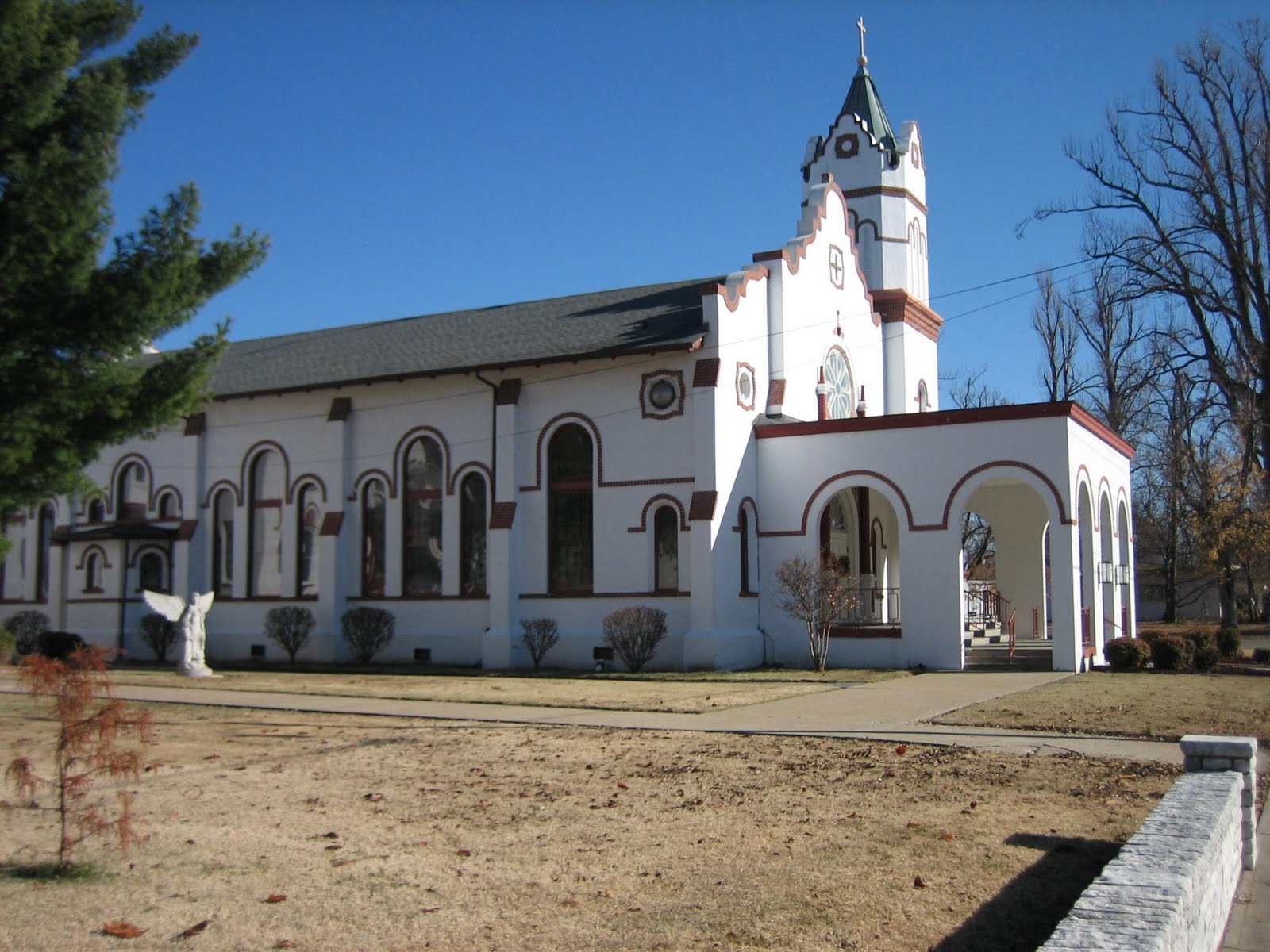
Chances are, most of us don't have relatives who will be remembered by history. With digital cameras, recorders, and the almighty Internet, our generation has become a documentary generation to the extreme. We document our own histories as they happen. But this is where we come from: a time without digital-ness, cell phones and Facebook. Yes, even you can remember that time. When you talk to your relatives, you can go back even further - a time without television, a time when people only had two pairs of shoes: regular and church. Part of me comes from a land of ladies with southern accents and pecan trees. It's hard to believe there's such a hot place in my history when I'm living in a Minnesotan tundra. My entire maternal family went to the same Catholic school and church.


That's the one. St. Eustachius, founded 1905. My grandparents and parents were married here.
My mom and all her sisters went to school here.


The greatest thing about this kind of documenting, which is why I recommend everyone do it, is that it takes far less work than making a full-length motion picture documentary, although if you have the bucks and the know-how, you should probably do that kind. Society says (and I won't argue) that if you were born after 1979, chances are that technology has made you a complete narcissist. They're even removing Narcissistic Disorder from the fifth edition of Diagnostic and Statistical Manual of Mental Disorders because really, who doesn't have it nowadays? Well, here's what I discovered. Even people as old as my grandfather and great aunt love to talk about themselves. Ask one question and you'll get a story. Now go out and buy a digital voice recorder.
Align Left

Monday, November 1, 2010

A DIY kind of Wildness

For me, Fairchild's "wildness" suggests something instinctual, not learned, and evokes the conceit of Berryman's Dream Song 14, in which I see a comment on the loss of wildness to a growing disinterest in prolonged debate; what is the debate? Life.  The serene and the contentious alike hold no charm for Berryman's narrator, who suggests the loss of instinct.

In something of a response to question posed in KF's pervious post, a piece by Han Cheung, whose constant mobility is fueled by something akin to Berryman's "inner resources" which I will liken here to the wildness of children, that constant motion that was the means and the end.


-"The Valentine's Bear," Han Cheung

Monday, October 4, 2010

Love Letter for B.H. Fairchild

Recently, I had the pleasure of reading B.H. Fairchild's Early Occult Memory Systems of the Lower Midwest for a class whose discussion was led by Charles Baxter. He brought to light a question from the text: where has the wildness [of childhood] gone? I love the question, though I don't propose an answer today. In Early Occult Memory Systems, Fairchild is concerned with the former lives of adults, those who have since "settled down." They are written from a layered perspective - that of the youth and that of the present adult. The problem with memory-as-documentary, Baxter says, is that often your own experience outstrips your ability to understand it. Hearing that , I thought, this could also be a definition for poetry. It's quite similar to Adam Zagajewski's definition of poetry - "the place between inspiration and impediment."


heron and sunset, Lake of the Isles - Minneapolis


Mrs. Hill

B.H. Fairchild

I am so young that I am still in love
with Battle Creek, Michigan: decoder rings,
submarines powered by baking soda,
whistles that only dogs can hear. Actually,
not even them. Nobody can hear them.

Mrs. Hill from next door is hammering
on our front door shouting, and my father
in his black and gold gangster robe lets her in
trembling and bunched up like a rabbit in snow
pleading, oh I'm so sorry, so sorry,
so sorry, and clutching the neck of her gown
as if she wants to choke herself. He said
he was going to shoot me. He has a shotgun
and he said he was going to shoot me.
I have never heard of such a thing. A man
wanting to shoot his wife. His wife.

I am standing in the center of a room
barefoot on the cold linoleum, and a woman
is crying and being held and soothed
by my mother. Outside, through the open door
my father is holding a shotgun,
and his shadow envelops Mr. Hill,
who bows his head and sobs into his hands.

A line of shadows seems to be moving
across our white fence: hunched-over soldiers
on a death march, or kindly old ladies
in flower hats lugging grocery bags.

At Roman's Salvage tire tubes
are hanging from trees, where we threw them.
In the corner window of Beacon Hardware there's a sign:
WHO HAS 3 OR 4 ROOMS FOR ME. SPEAK NOW.
For some reason Mrs. Hill is wearing mittens.
Closed in a fist, they look like giant raisins.
In the Encyclopaedia Britannica Junior
the great Pharoahs are lying in their tombs,
the library of Alexandria is burning.
Somewhere in Cleveland or Kansas City
the Purple Heart my father refused in WWII
is sitting in a Muriel cigar box,
and every V-Day someone named Schwartz
or Jackson gets drunk and takes it out.

In the kitchen now Mrs. Hill is playing
gin rummy with my mother and laughing
in those long shrieks that women have
that make you think they are dying.

I walk into the front yard where moonlight
drips from the fenders of our Pontiac Chieftain.
I take out my dog whistle. Nothing moves.
No one can hear it. Dogs are asleep all over town.